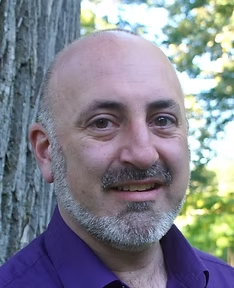
Seaghan Coleman
Seaghan is a master therapist, consultant, and trainer who specializes in trauma and sustainable growth. He works with individuals seeking lasting transformation and only taking new clients for ketamine-focused work.
Contact NowSeaghan is a master therapist, consultant, and trainer who specializes in trauma and sustainable growth. He works with individuals seeking lasting transformation and only taking new clients for ketamine-focused work.
Contact NowMaster Therapist · Clinical Trainer · Ketamine-Assisted Psychotherapy Specialist
Samadhi Healing Collective · Buffalo, NY
Currently ONLY accepting new clients for focus on Ketamine-Assisted Psychotherapy
Many of us long to open, connect, and live with greater freedom. Ketamine-Assisted Psychotherapy offers a safe, profound way to process trauma and break through rigid survival patterns—accessing parts of ourselves that have long been buried beneath fear, shame, and old identities.
By softening the Default Mode Network—the brain's hub of ego and self-protection—KAP opens the door to expanded states of awareness, deep emotional release, and spiritual reconnection. Clients access deeper meaning, restore connection, and begin to recognize how trauma, conditioning, and survival roles have shaped their disconnection from their true nature.
This work guides people back to who they are at their core: awake, kind, and free.
What distinguishes this work is that it is therapist-led, spiritually integrated, and grounded in deep clinical experience with trauma. KAP here is not a standalone medical procedure—it is woven into a larger therapeutic relationship, informed by contemplative practice, and held within a framework that honors both the psychological and the sacred dimensions of healing. If you're ready to go beyond surface-level work and step into deep, integrated change, this may be for you.
I'm a master therapist, clinical trainer, and consultant with nearly two decades of experience. I specialize in helping clients break through trauma, attachment wounds, emotional stuckness, and self-limiting patterns. In addition to KAP, I integrate several powerful modalities—each chosen purposefully to help you move toward greater clarity, aliveness, and connection.
I'm a certified EMDR therapist and EMDRIA-Approved Consultant. EMDR helps reprocess painful memories so they no longer fuel distress or dysfunction. I'm also researching the integration of psycholytic ketamine doses with EMDR for clients with dissociative presentations—and exploring EMDR as a gateway to non-ordinary states of consciousness.
A mindfulness-based model that supports action and growth even in the face of intense thoughts or emotions. ACT emphasizes values-based living—building a life on unconditional foundations like love, wisdom, and equanimity rather than impermanent conditions.
Rooted in my personal spiritual path, especially the somatic work of Reggie Ray and Vajrayana Buddhist traditions. This perspective informs everything I do—from how I understand suffering to how I hold space for transformation.
Drawing on archetypal symbols, visionary states, and intuitive knowing to guide inner healing and integration. These perspectives honor the depth and mystery of the human experience.
Working with internal systems to understand and compassionately engage the different parts of ourselves—including those born from trauma and survival—so they can begin to soften, trust, and release.
The work I offer doesn't come only from clinical training. It comes from decades of walking the path myself—through sustained contemplative practice, through suffering, and through deliberate exploration of the deeper territories of consciousness.
My contemplative life is deeply eclectic—rooted in Buddhist traditions but nourished by many streams. I have practiced extensively with teachers across lineages: the somatic ego-dissolution work of Reggie Ray, where we look directly for the self and find only openness; Sharon Salzberg's metta and mindfulness of the breath; Joseph Goldstein's luminous investigations in the Abiding series; the Theravada emphasis carried by Jack Kornfield that we are already enlightened, already whole, already deserving of deep reverence; Thich Nhat Hanh's teachings on dependent arising and "no separate self"; the clarity of Mingyur Rinpoche; the Bön and Dzogchen practices of Tenzin Wangyal Rinpoche—and so many more.
This is not a weekend interest or an intellectual add-on to my clinical work—it is the ground I stand on. Years of daily practice in sitting meditation, somatic awareness, breathwork, and embodied contemplation have shaped how I understand the human mind, how I hold space for others, and how I relate to suffering itself.
Through these practices, I've learned to meet what arises—grief, fear, joy, emptiness—with presence rather than reactivity. That capacity is what I bring into every session. When I sit with a client in the midst of a ketamine journey or a deeply activated EMDR session, I'm drawing on more than technique. I'm drawing on a lived relationship with silence, with the body, and with the vast awareness that contemplative traditions point toward.
I also maintain an active presence on Insight Timer, where I curate meditation resources for clients and contribute to the wider contemplative community.
I identify as a psychonaut—from the Greek psychē (soul, mind) and nautēs (sailor, navigator). A psychonaut is someone who engages in deliberate, disciplined exploration of consciousness through practices that access non-ordinary states of awareness: meditation, breathwork, fasting, ceremonial practice, and, when used with intention and reverence, psychedelic medicines.
This is not casual or recreational territory. Psychonautic exploration is an ancient human endeavor—present in shamanic traditions, contemplative monasticism, and the mystery schools of nearly every culture. It asks: What lies beyond the stories the ego tells? What do we find when the Default Mode Network quiets and the deeper mind opens?
My own explorations over many years have taken me into states of profound interconnection, encounters with what felt like wise and real presences, dissolution of ordinary boundaries of self, and direct experiences of the love, unity, and spacious awareness that contemplative traditions describe. These are not things I merely believe in—they are territories I have visited, sat with, and returned from, again and again.
This matters clinically. When a KAP client encounters beings during a journey, when they dissolve into what feels like infinite love, when they see through the illusion of separateness for the first time—I am not observing from the outside. I recognize the territory. I can help them navigate it, integrate it, and bring its wisdom back into their daily lives. My contemplative practice and psychonautic experience are not separate from my clinical work. They are the foundation of it.
What I've found, through both personal practice and thousands of clinical hours, is that different paths lead to the same deeper territory. Sustained meditation quiets the Default Mode Network. EMDR's bilateral stimulation may access similar neural shifts. Psychedelic medicines temporarily dissolve ego structures. And in all three, people encounter remarkably consistent truths: that separateness is an illusion, that love is fundamental, that awareness itself is vaster than any identity we construct.
This convergence is not coincidental—it is the basis for everything I do at Samadhi Healing Collective. My research exploring EMDR as a gateway to non-ordinary states of consciousness, my integration of psycholytic ketamine with trauma processing, and my grounding in Buddhist psychology all emerge from the same deep inquiry: What are we, really, when the walls come down?
Too much therapy becomes an open-ended conversation with no clear direction. I work differently. Together, we develop a structured, functional treatment plan so each session carries momentum and purpose.
Therapy with me is a collaborative process grounded in authenticity and mutual respect. I bring not only clinical skill but my own lived experience. I know what it means to suffer—and I know the path of healing from the inside.
We are all travelers on the path of healing. I bring many years of my own ongoing spiritual practice and commitment to meeting what still needs compassion and clarity in myself. I don't hide behind jargon or distance. I show up human, direct, and honest.
I've taught in graduate programs, led trainings for mental health agencies, and mentor other therapists in integrative trauma work and psychedelic-assisted therapy. I teach many of the models I use because I believe in their power—and I want to share that power with others.
At the heart of all my work is a spiritual commitment rooted in my Buddhist practice. I orient my life and service around the Bodhisattva vow:
Suffering beings are numberless, I vow to liberate them all.
Attachments are inexhaustible, I vow to release them.
The gates of truth are infinite, I vow to walk through them.
This vow fuels my belief that we can all heal—not just from mental illness or trauma, but from the core disconnection that keeps us from being truly alive and free.
Whether you're called to Ketamine-Assisted Psychotherapy, trauma healing, spiritual inquiry, or psychedelic integration, I welcome you into a space of depth, safety, and possibility.